
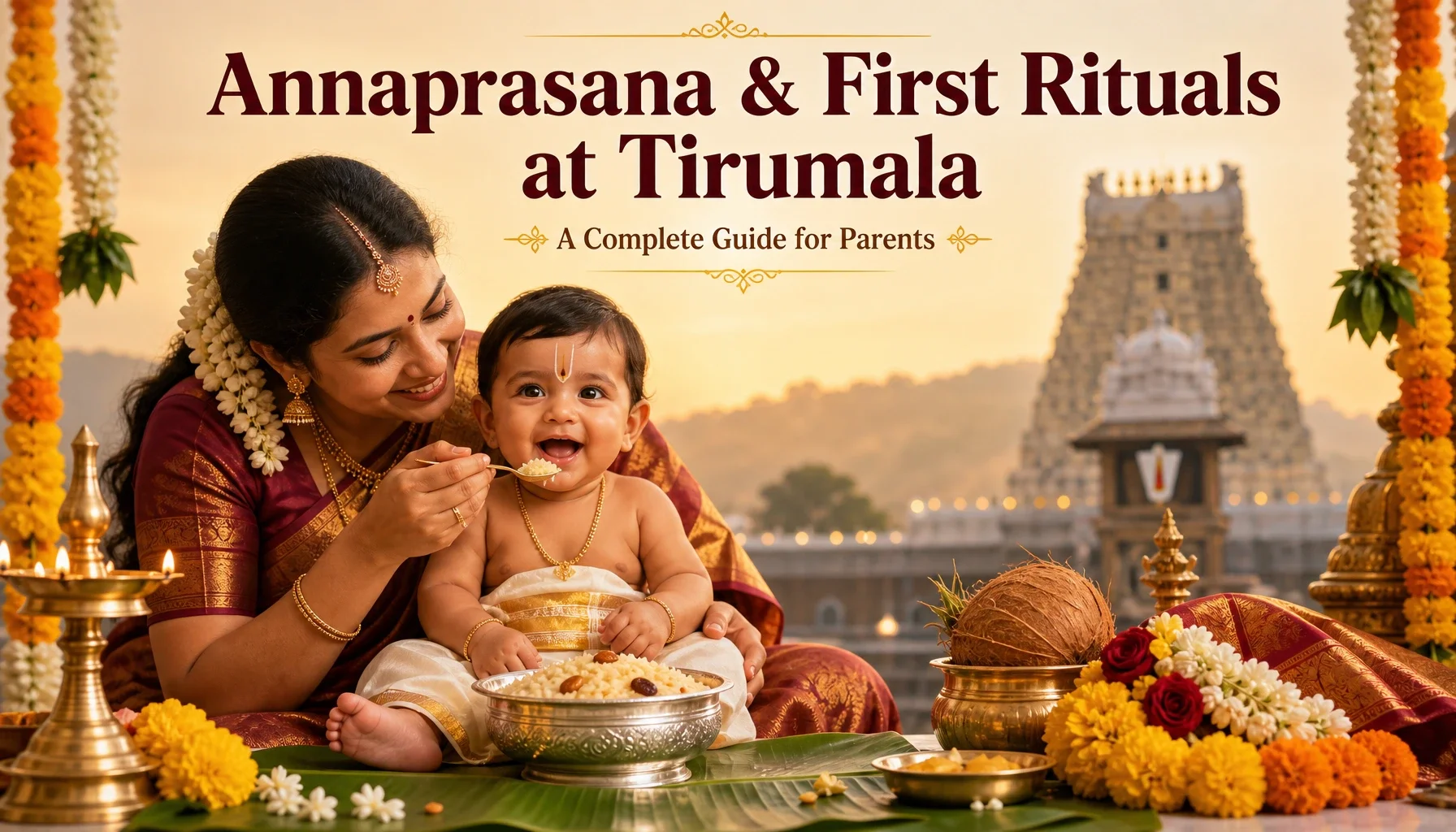
Bringing a baby to Tirumala for their first sacred milestones is a deeply cherished tradition for millions of families. The hills of Sri Venkateswara Swamy are, for many South Indian households, the natural place to mark a child's earliest rites of passage — the first taste of solid food, the first offering of hair, the first piercing of the ears, and the child's first darshan of the Lord.
Table of Contents
This guide walks you through each of these rituals as they are actually performed at Tirumala: what they mean, where they happen, what they cost, how to book, and the practical logistics of doing them with an infant in tow.
Understanding the First Rituals
In the Hindu samskara tradition, a child's early life is marked by a series of sacraments. Several of these are commonly fulfilled at Tirumala, either because the family has taken a vow (mokku) or simply out of devotion. The four most relevant for parents visiting the hill are:
- Annaprasana — the ceremonial first feeding of solid food (rice), usually around 6 months of age.
- Mundan / Chaula (Tonsure) — the first offering of the child's hair, performed at the Kalyana Katta.
- Karnavedha (Ear-Piercing) — the piercing of the child's ears.
- Infant Darshan — a dedicated, less crowded darshan queue for families travelling with babies.
Not every family performs all four on the same trip. Many combine the tonsure and first darshan, and perform Annaprasana at a temple or at home closer to the auspicious date. Understanding what Tirumala itself facilitates versus what you arrange privately is the key to planning well.
Annaprasana (First Rice Ceremony) at Tirumala
infant Darshan at Tirumala – Complete Guide for Mothers with Babies
What it is
Annaprasana marks the moment a baby transitions from milk to solid food. The ritual centres on feeding the child a small quantity of cooked rice — often sweetened as payasam or mixed with ghee — for the first time, accompanied by prayers for the child's health, longevity, and prosperity. In many families the child is also presented with symbolic objects (a coin, a book, a pen, a piece of jewellery) to "choose" from, a playful tradition believed to hint at the child's future inclinations.
The Tirumala context
It is important to be clear: TTD does not operate a dedicated, ticketed "Annaprasana seva" counter in the way it runs Kalyanotsavam or Arjitha sevas. Annaprasana is a family samskara rather than a temple arjitha seva. Families who wish to perform it at Tirumala typically do so in one of these ways:
- After darshan, using temple prasadam. Many parents perform a simple, heartfelt Annaprasana by feeding the baby their first morsel of Sri Venkateswara Swamy's prasadam — often a small piece of the famous Tirupati Laddu or a spoon of daddojanam (curd rice) / pulihora — after receiving darshan. This is the most common and most accessible approach.
- Through a priest arranged privately. Some families engage a purohit to perform a fuller ceremony with mantras, either at their accommodation in Tirumala/Tirupati or at an associated temple, timed to an auspicious muhurtham.
- At home, with Tirumala prasadam. Families who cannot align the auspicious date with their trip carry back Tirumala prasadam and perform the ceremony at home.
- Vaikunta Ekadasi at Tirumala: Why Devotees Crowd, What Makes It Special, and How to Plan Your Darshan
Choosing an auspicious time
Annaprasana is traditionally performed in the sixth or eighth month for boys and an even month for girls, on a day and muhurtham selected by a family priest. If aligning the exact muhurtham with your Tirumala visit is difficult, prioritise the darshan and tonsure at the hill and perform the formal Annaprasana on the correct date separately — devotion is not diminished by doing so.
Mundan / Tonsure at the Kalyana Katta
The offering of a child's first hair is one of the most widely observed vows at Tirumala. Hair is offered to the Lord as a symbol of surrendering ego and giving thanks — the origin of the enormous quantities of hair the temple receives and manages daily.
Where it happens
Tonsure is performed at the Kalyana Katta, TTD's dedicated tonsure complexes. The main Kalyana Katta is located near the temple; there are additional tonsure halls (including facilities operating around the clock) to handle the huge volume of pilgrims. Barbers are TTD-employed and work in hygienic, supervised halls.
Cost and process
- The tonsure itself is free of charge; TTD does not levy a fee for the barber's service. A modest voluntary tip to the barber is customary but not required.
- Carry your own new razor blade if you prefer, though TTD supplies fresh blades. Hygiene has improved significantly with single-use blades and supervised halls.
- Expect queues during peak season. Early morning is generally the calmest window.
- After the tonsure, the child's head is traditionally smeared with sandal paste (and sometimes turmeric); many families then bathe the baby before proceeding to darshan.
Practical tips for babies
- A first tonsure can distress an infant. Bring a familiar comfort item, feed the baby beforehand, and keep a spare set of clothes and a towel handy.
- The offered hair is collected by TTD; you do not take it with you.
- Protect the freshly shaved scalp from direct sun — a light cotton cap for the walk to the temple helps.
Karnavedha (Ear-Piercing)
Ear-piercing is another samskara some families choose to perform at Tirumala, often on the same trip as the tonsure. TTD does not run a formal ear-piercing seva counter, so this is generally arranged privately — either through a family priest with a goldsmith, or performed at home on an auspicious date. If you intend to combine it with your visit, arrange the practitioner and muhurtham in advance rather than expecting a temple facility.
Infant Darshan: The Most Important Facility for Parents
This is the single most useful thing to know when travelling to Tirumala with a baby.
What it is
TTD provides a special darshan facility for infants and their parents, designed to spare families with very young children the long waits and crush of the general queue. Under this facility, a couple travelling with an infant is permitted a much quicker darshan.
Key points
- The facility is intended for parents with a small child / infant. Typically both parents plus the child are accommodated together so the family stays as a unit.
- It runs from a designated entry point; TTD periodically updates the exact location and timings, so confirm on arrival at the enquiry office or with TTD staff.
- This is one of the genuinely compassionate provisions TTD makes, and it dramatically reduces stress for families with babies. Do not attempt the ordinary long queue with an infant if the infant/senior-citizen facility is available.
Always verify current infant darshan timings, the entry point, and any documentation (such as the child's age proof) directly with TTD, as these details are updated from time to time.
Suggested Order of the Day
For families planning to combine rituals in a single visit, a practical sequence is:
- Early arrival and freshening up at your accommodation.
- Tonsure at the Kalyana Katta first, so the baby is bathed and clean before darshan.
- Bathe the baby and change into fresh clothes.
- Infant Darshan of Sri Venkateswara Swamy.
- First morsel of prasadam — a gentle, meaningful way to mark the child's first taste of the Lord's food, whether or not you perform a full formal Annaprasana.
- Collect prasadam / Laddu to carry home.
SSD Tokens in Tirupati for Free Darshan – Counters, Timings & How to Reach (2026 Guide)
What to Carry for a Baby at Tirumala
- Age-appropriate ID or age proof for the child (useful for the infant facility).
- Spare clothes, a towel, and a light cap.
- Feeding essentials, water, and any medication.
- A carrier or sling — the walk and queues are easier hands-free.
- Warm layers: Tirumala sits at altitude and mornings and nights can be cool even when Tirupati below is warm.
Accommodation and Timing
Booking TTD accommodation or a nearby guesthouse in advance makes ritual mornings far less stressful, since you'll want to reach the Kalyana Katta early. Weekdays and the off-peak months are considerably calmer than weekends, public holidays, and festival periods such as Brahmotsavam. If your ritual has a fixed muhurtham, build in a buffer day in case queues or crowds run long.
Frequently Asked Questions
Does TTD have a dedicated Annaprasana seva ticket? No. Annaprasana is a family samskara rather than a ticketed arjitha seva. Most families perform it by feeding the baby their first morsel of the Lord's prasadam after darshan, or engage a private priest for a fuller ceremony.
Is the tonsure at Kalyana Katta free? Yes, the tonsure service is free. A small voluntary tip to the barber is customary but not mandatory.
Can I do the tonsure and darshan on the same day? Yes, and it's the usual practice. Perform the tonsure first, bathe and change the baby, then proceed to darshan.
Is there a special queue for babies? Yes. TTD provides a special infant darshan facility so parents with a small child can have a much quicker darshan. Confirm the current entry point and timings on arrival.

What is the right age for these rituals? Annaprasana is typically around six to eight months; tonsure and ear-piercing dates are chosen by the family priest on an auspicious muhurtham. There is flexibility, and many families perform the tonsure and first darshan whenever they are able to travel.
Do I get to keep the baby's hair after the tonsure? No, the offered hair is collected by TTD as part of the offering to the Lord.
Ritual details, timings, and facilities at Tirumala are periodically revised by TTD. Please verify current arrangements with the official TTD enquiry office or website before finalising your plans.
