
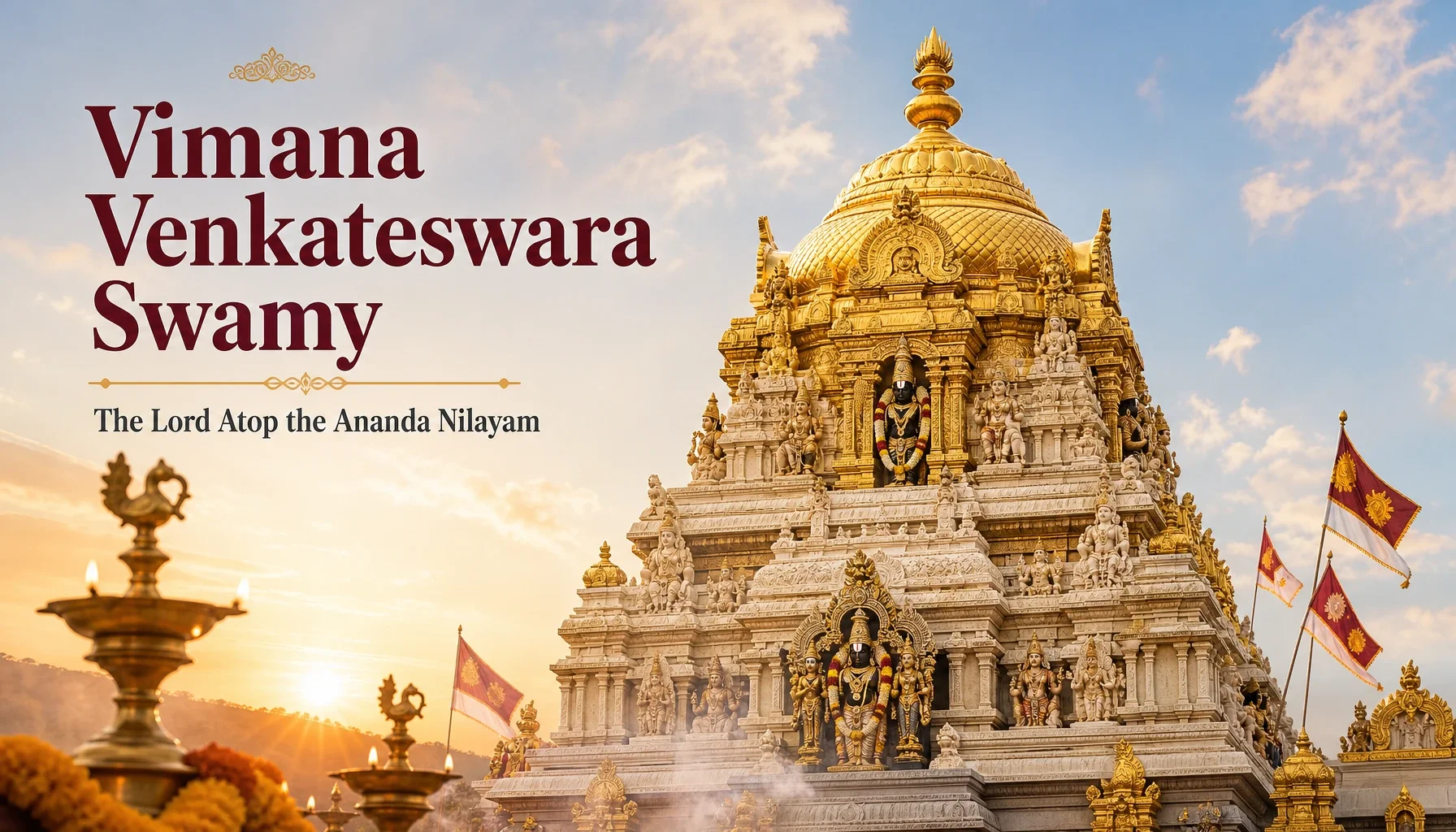
Every day, lakhs of pilgrims climb the seven hills of Tirumala with a single longing — a glimpse of Sri Venkateswara Swamy in the sanctum sanctorum. Yet as devotees move through the temple's inner circumambulatory path, many pause, fold their hands, and pray facing upward — not toward the sanctum, but toward a small, silver-framed image glittering on the golden tower above it. This is Vimana Venkateswara Swamy, one of the most quietly revered forms of the Lord at Tirumala, whose darshan is believed by devotees to be equal in merit to the darshan of the Moola Virat (the main deity) himself.
Table of Contents
The Ananda Nilayam: The Abode of Bliss
To understand Vimana Venkateswara, one must first understand the structure on which he resides. The gold-covered tower that rises directly above the sanctum sanctorum of the Tirumala temple is called the Ananda Nilayam, meaning "the Abode of Happiness" or "Abode of Bliss." Unlike the tall entrance gopurams of South Indian temples, this is a vimana — the sacred canopy built over the garbha griha (sanctum) itself, and in the Agamic tradition it is treated not as mere architecture but as an extension of the deity's own divine body.
The Ananda Nilaya Vimanam is a three-tiered structure built in the Dravidian style, adorned with numerous sculpted images of deities on all its faces. According to temple lore, the vimana was not built by human hands at all — tradition holds that Garuda, the divine vehicle of Lord Vishnu, brought the Ananda Nilaya Vimanam down from Vaikuntham (Vishnu's celestial abode) and installed it on the hill at the Lord's own wish. Puranic texts associated with the shrine, including passages attributed to the Vamana Purana, describe sages such as Agastya beholding the Lord manifest within a radiant, gem-studded vimana on the banks of the Swami Pushkarini — a foreshadowing of the sacred tower that stands today.
Historically, the vimana has been gilded and re-gilded several times across the centuries by the Pandya, Pallava, and Vijayanagara rulers, each dynasty considering the gold-plating of the Ananda Nilayam among the highest acts of devotion. In 1908, a golden kalasam (finial) was fixed atop the vimana. In the modern era, the Tirumala Tirupati Devasthanams (TTD) conducted the grand Ashta Bandhana Maha Samprokshanam in 1964 to consecrate the renewed golden vimana, and this purificatory ceremony has been repeated roughly once every twelve years since, with the gold sheets receiving fresh polish during the 2006 ceremony.
SSD Tokens in Tirupati for Free Darshan – Counters, Timings & How to Reach (2026 Guide)
Who is Vimana Venkateswara Swamy?
On the north-western corner of the second tier of the Ananda Nilaya Vimanam stands a small sculpted image of Lord Venkateswara — a miniature replica of the Moola Virat inside the sanctum, standing in the same majestic posture. This image is Vimana Venkateswara Swamy.
Among the dozens of sculpted figures that decorate the vimana, this one alone is set apart in a striking way: it is framed in silver, with a silver tiruchi (canopy/marker) and a name board, so that devotees walking the inner pradakshinam can identify it instantly amid the sea of golden figures. An arrow and marker were historically added precisely so that no pilgrim would miss it. Devotees stop at this point on the circumambulatory path, gaze up at the shining image, and offer their prayers with the firm belief that this darshan carries the same spiritual potency as standing before the main deity in the Garbha Griha.
The Legend of Sri Vyasa Tirtha
The most historically grounded reason for the special sanctity of Vimana Venkateswara centres on Sri Vyasa Tirtha (Vyasaraya), the towering 16th-century Madhva saint, scholar, and rajaguru of the Vijayanagara empire.
Vyasa Tirtha served for a period as the officiating priest performing worship to the Lord at Tirumala, and Kannada devotional tradition remembers his association with the shrine with great pride. According to tradition, the saint attained moksha (liberation) by steadfastly worshipping and meditating upon the small image of Lord Venkateswara on the corner of the Ananda Nilaya Vimanam. Because a soul of his stature reached the highest goal through devotion to this very image, the Vimana Venkateswara came to be regarded as spiritually equivalent to the Lord within — and the practice of venerating it took deep root among pilgrims.
The Haridasa saints of Karnataka celebrated this form in their compositions. Vijaya Dasa sang salutations to the golden tower on which Vimana Srinivasa is installed, and Prasanna Venkata Dasa echoed the same reverence in his verses — testimony to how deeply this form of the Lord entered the devotional imagination of the Dasa tradition.
The Krishnadevaraya connection
A widely told narrative links the image's prominence to a dark episode during the reign of Sri Krishnadevaraya, the great Vijayanagara emperor and disciple of Vyasa Tirtha. The story goes that during a visit to Tirumala, the emperor discovered priests wearing ornaments belonging to the Lord and, in a fit of rage, had them executed within the temple precincts. To atone for this grave sin of bloodshed in the shrine, Vyasa Tirtha is said to have had the temple ritually closed for a long period of purification. During this time, the Lord appeared to the saint in a dream and instructed that devotees be directed to worship the replica of his image on the vimana outside — and so the already-existing carved image was marked out with a silver frame, allowing worship to continue even while the sanctum was inaccessible.
Like many temple traditions, this account survives in several versions and blends history with hagiography, but it beautifully explains the core belief: when darshan of the Moola Virat is not possible, darshan of Vimana Venkateswara grants the same grace.
The Kubera legend
Another charming legend ties the image to the famous story of the Lord's debt. When Srinivasa borrowed enormous wealth from Kubera, the treasurer of the gods, to celebrate his wedding with Goddess Padmavati, Kubera is said to have grown anxious — what if the Lord, hidden away inside the sanctum, were ever to vanish without repaying? To reassure him, the Lord promised that his exact prototype would be placed openly on the vimana, visible to all at all times, as a standing guarantee of his eternal presence on the hill. The Vimana Venkateswara thus becomes the Lord's own signature — proof, cast in gold, that he resides at Tirumala until the end of the Kali Yuga.
The Vimana as Deity: Ritual Significance
Kalyana Katta: Head Tonsure (Mundan) at Tirumala – Complete Guide

In the Vaikhanasa Agama tradition followed at Tirumala, the vimana itself is worshipped as a divine presence. The Ashtottara Shatanamavali (108 names) of Sri Venkateswara includes names saluting the Lord as the one residing within the vimana that came from Vaikuntham, and as the one whose vimana is veiled in divine maya.
Tradition recorded in the Tirumalai Ozhugu, the temple's historical register, holds that when Sri Ramanujacharya visited Tirumala and settled the ancient dispute over the identity of the deity — establishing conclusively that the Lord of the Seven Hills is Narayana — he performed a full Samprokshanam according to the Vaikhanasa Agama and installed images of Varaha, Narasimha, Vaikunthanatha, and Srinivasa on the four sides of the vimana. The vimana thus carries the Lord's presence on every face, with the Vimana Venkateswara image being the most celebrated among them.
The image also has its own place in the temple's ritual calendar. On Kanuma day (the day after Sankranti), in the early hours, the archakas perform the special Kaka Bali ritual: cooked rice mixed separately with turmeric and vermilion is ceremonially offered to the Ananda Nilaya Vimana Venkateswara, after which the processional deities Malayappa Swamy and Sri Krishna proceed to the Paruveta Mandapam in the Seshachalam forests for the ritual hunt festival.
Where and How to Have Darshan
Pilgrims encounter Vimana Venkateswara Swamy along the inner circumambulatory path (Vimana Pradakshinam) around the sanctum, after exiting the main darshan queue. This pathway is ringed by the chuttu gullu — the sub-shrines encircling the main temple — and passes several sacred spots in sequence: the shrine of Sri Ranganatha opposite the silver entrance, the Sri Varadaraja Swamy temple, the main kitchen (potu), the golden well (Bangaru Bavi), the Ankurarpana Mandapam and Yagasala, the Parakamani (where hundi offerings of coins and notes are counted), the sandal-paste chamber, and then the darshan point of Vimana Venkateswara, followed by the seat of Sri Ramanuja (Sannidhi Bhashyakarulu), the Yoga Narasimha Swamy shrine, the Srivari Hundi, and the seat of Vishvaksena.
At the darshan point, devotees look up toward the north-western face of the golden vimana. The silver-framed image is unmistakable. Many pilgrims — especially on days of overwhelming crowds, when their moment before the Moola Virat lasts barely a second or two — linger here, taking in a longer, calmer darshan of the Lord on the tower. Temple guides and elders often advise pilgrims never to leave Tirumala without consciously offering pranams to Vimana Venkateswara, for tradition holds that:
- His darshan equals darshan of the main deity — carrying the same power to destroy sins and confer auspiciousness.
- Worship of this image is believed to lead the devotee toward moksha, following the example of Sri Vyasa Tirtha.
- He is the Lord's ever-visible form — while the Moola Virat is enclosed within the sanctum, Vimana Venkateswara stands in the open sky, blessing all who look up, at all hours the temple is open.
Why This Small Image Matters So Much
There is something profoundly moving in the theology of Vimana Venkateswara. Tirumala is the busiest pilgrimage centre in the world, and for the ordinary devotee, the climactic moment before the sanctum is fleeting — a heartbeat's glimpse before the flow of the queue carries them onward. The Vimana Venkateswara answers this ache. He is the Lord who stepped out of the sanctum, so to speak, and stationed himself on the rooftop where no queue hurries anyone along, where a devotee may stand and gaze as long as the heart desires.
He is also a symbol of accessibility woven into the temple's own history — the form worshipped when the sanctum itself was closed, the assurance given to an anxious Kubera, the image upon which a great saint meditated his way to liberation. In the Vimana Venkateswara, the tradition affirms that the Lord of the Seven Hills is never truly hidden: he shines above his own temple, in gold and silver, under the open sky, for every eye that seeks him.
Om Namo Venkatesaya.
