
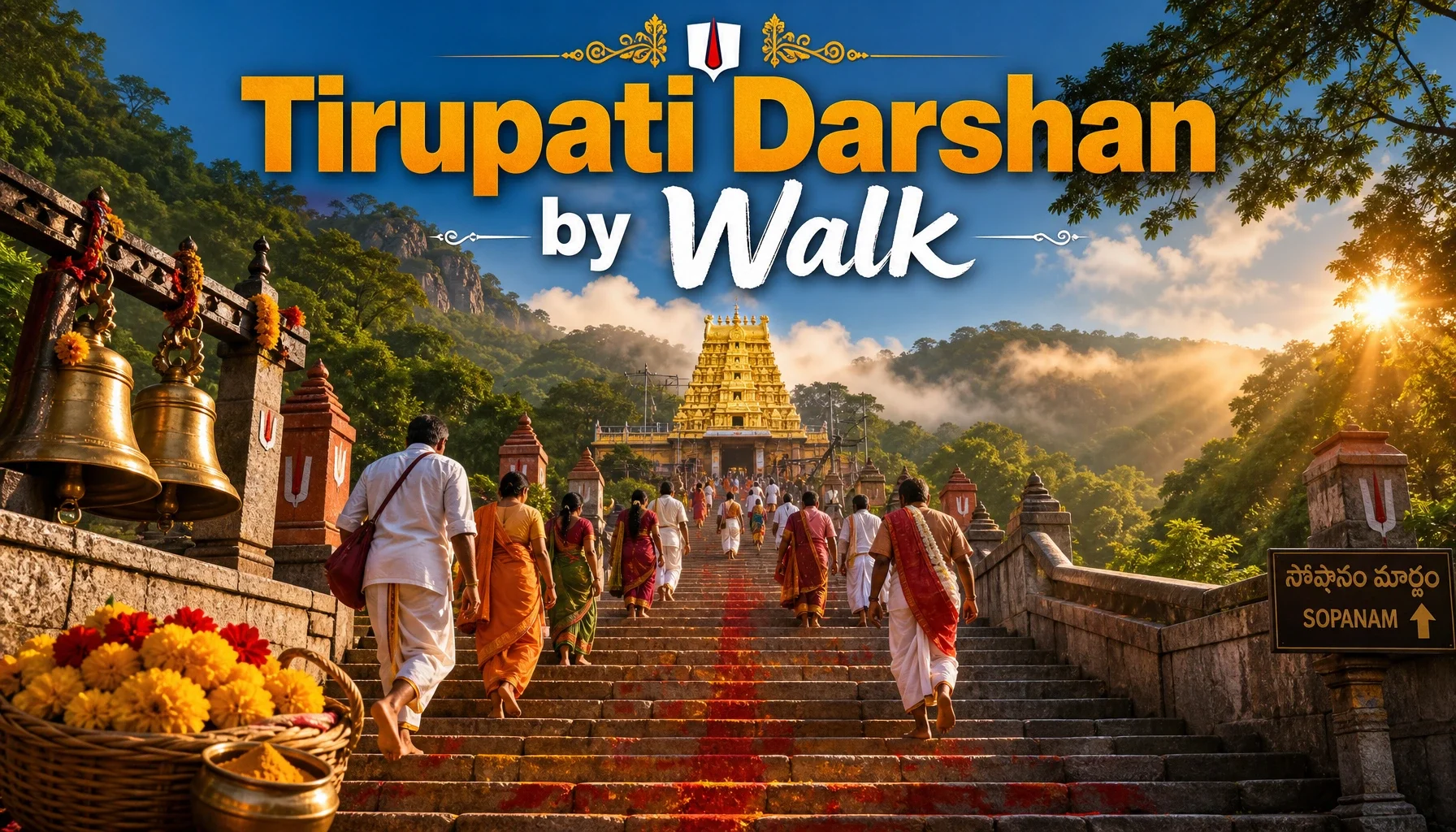
Walking up the seven hills to the feet of Lord Sri Venkateswara (Balaji) at Tirumala is one of the most cherished acts of devotion a pilgrim can undertake. Generations of devotees have climbed these stone steps as penance, to fulfil a vow (mokku), or simply to feel the sacred ascent that older pilgrims had no choice but to make on foot. Today the path is well-maintained, roofed, lit and supported by TTD facilities — but it still demands preparation. This guide covers the routes, distances, timings, facilities, safety and TTD guidelines you need before you start.
Table of Contents
The Two Footpath Routes
There are two stone footpaths (called Sopana Marg) leading up to Tirumala. Both qualify pilgrims for Divya Darshan, a free, quicker darshan facility reserved for those who climb on foot.
1. Alipiri Mettu (the traditional route)
- Starting point: Alipiri, at the foot of the Sheshachalam hills, marked by a large Garuda statue. Also called Alipiri Padala Mandapam — the "Gateway to Tirumala."
- Distance: Approximately 9 to 9.8 km from base to hilltop.
- Steps: Around 3,550 steps (some sources cite up to 3,600).
- Time to climb: Roughly 3 to 5 hours depending on fitness; a fit adult typically takes 2.5–3 hours, while elderly pilgrims or families with children should plan for 4–5 hours.
- Distance from Tirupati bus stand / railway station: About 4 km (free TTD buses available).
- Character: Longer but more gradual, scenic, and well-shaded. The most popular and spiritually significant route. The initial stretch is the steepest, then it eases.
2. Srivari Mettu (the shorter route)
- Starting point: Near Srinivasa Mangapuram, close to Chandragiri.
- Distance: Approximately 2.1 km.
- Steps: Around 2,388 steps.
- Time to climb: Roughly 1.5 to 3 hours.
- Distance from Tirupati bus stand: About 16–18 km.
- Character: Much shorter but considerably steeper. Better for those with limited time or stamina, but harder on the legs. It has a smaller daily token quota.

A quick word on choosing: pick Alipiri if you want the longer, gradual, traditional climb; pick Srivari Mettu if you want a quicker but steeper ascent.
Allowed Timings for the Climb
Timings can change on festival days or when wildlife or security advisories are active, so always confirm at the base on the day of your climb.
Alipiri Mettu: The footpath is officially open 24 hours. However, for safety, independent (unsupervised) climbing is best done between roughly 4:00–5:00 AM and around 2:00 PM. After about 2:00 PM, due to wildlife movement (leopards and bears have been reported in the surrounding forest), movement may shift to supervised group walks only, with a general night closure around 9:00–9:30 PM. Children under 12 may be restricted from starting after mid-afternoon on some days.
Srivari Mettu: Open roughly 6:00 AM to 5:30–6:00 PM only — stricter, with afternoon closure.

Best time to start: Early morning, between 5:00 and 7:00 AM. These are the coolest hours, with the lightest crowds and smoothest movement through the security checkpoints.
Tokens and Darshan — How It Works
Walking does not automatically give you a shorter darshan queue, but climbing qualifies you for the Divya Darshan token system:
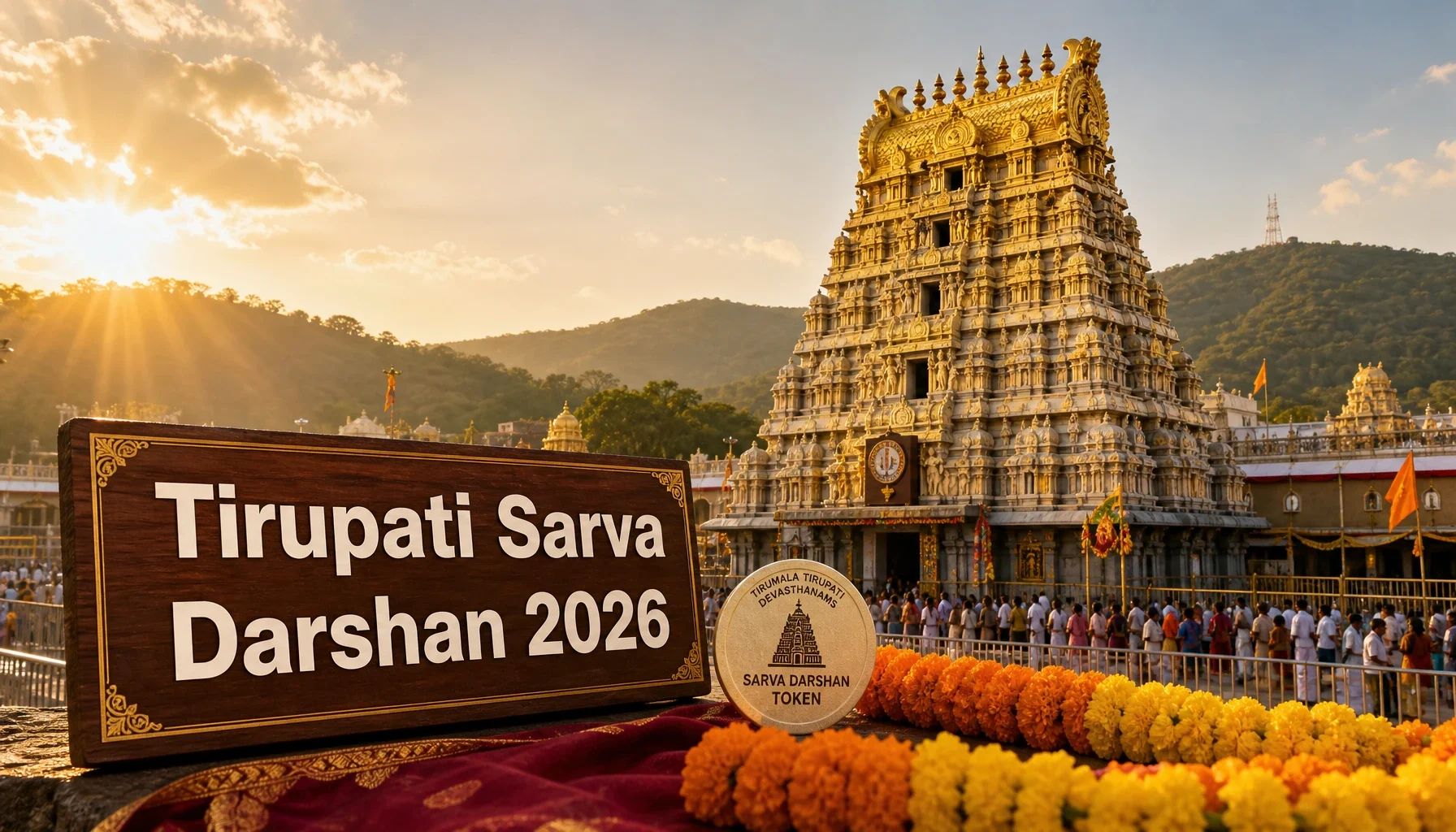
- Pilgrims who trek either route receive a free Divya Darshan bio-metric token.
- On Alipiri, the token / biometric registration happens around the Gali Gopuram checkpoint (about the 2,083rd step); on Srivari Mettu, around the 1,240th step.
- Carry the token all the way up — it is checked at multiple points and is also required to collect your complimentary laddu prasadam after darshan.
- A daily quota applies (commonly cited around 14,000 tokens at Alipiri and around 6,000 at Srivari Mettu); once exhausted, remaining pilgrims go through Sarva Darshan (free darshan).
- After reaching Tirumala, report at the designated queue complex within the time/window indicated on your token. Early or late reporting may not be accepted.
- Carry a valid photo ID (Aadhaar/passport) for every climber — IDs are verified at token counters.
Facilities Along the Way
TTD has built extensive support along both paths:
- Covered, roofed walkways over most of the route, protecting from sun and rain, with lighting for early-morning and night climbers.
- Free TTD buses from Tirupati Railway Station and Bus Stand to both starting points.
- Free luggage transfer service — deposit heavy bags at the base counter and collect them at Tirumala (Alipiri trekkers collect at the GNC counter; Srivari Mettu at the MBC counter). This lets you walk hands-free.
- Drinking water stations / filtered taps at multiple points.
- Rest shelters / mandapams for breaks along the climb.
- Eateries and food outlets at intervals.
- Medical outposts and emergency facilities along the route.
- Free accommodation and food for Divya Darshan pilgrims as part of the facility.
Health Check-up and Safety Guide
The climb is a sustained physical effort — equivalent to climbing a tall mountain stairway over several hours.
- Before you go: If you have heart conditions, high blood pressure, asthma, joint/knee problems, or are pregnant or elderly, consult your doctor first. Consider the shorter Srivari Mettu or simply take the bus if in doubt.
- Footwear: Wear comfortable, well-cushioned walking shoes or sturdy footwear. (Note: many devotees climb barefoot as a vow — if you do, the roofed path helps, but pace yourself.)
- Pace yourself: Don't rush the steep initial stretch. Rest at the shelters; treat it as a multi-hour effort, not a race.
- Hydration and snacks: Carry water and light snacks; refill at the water stations.
- Warm-up: Stretch your legs before starting to reduce cramps.
- Weather: Early morning is coolest. Avoid the peak afternoon heat.

Medical Help and Emergencies
- Medical outposts are stationed at intervals along both footpaths.
- Emergency facilities are available on the route; TTD staff and security are positioned at the checkpoints.
- If you or a fellow pilgrim feels chest pain, severe breathlessness, dizziness, or faintness, stop immediately, rest at the nearest shelter, and alert the nearest TTD staff or security personnel.
- Keep a list of any personal medications and emergency contact numbers with you.
- Note the location of checkpoints (e.g., Gali Gopuram, Narasimha Swamy temple security point) as reference points if you need to direct help to your location.
Do's and Don'ts While Walking / Climbing
Do:
- Start early in the morning for the safest, coolest, smoothest climb.
- Carry a valid photo ID for each person and keep your token safe throughout.
- Use the free luggage transfer so you can walk light.
- Stay in a group, especially if starting later in the day (after ~2 PM).
- Follow all on-ground instructions from TTD security and staff.
- Rest at shelters and stay hydrated.
- Maintain cleanliness — use bins; respect the sanctity of the path.
- Wear modest / traditional attire (recommended for darshan).
Don't:
- Don't assume the path is open without restriction at all hours — night closure and supervised-group rules apply, especially after ~2 PM.
- Don't start a late/evening climb alone, particularly with children or elderly members.
- Don't carry prohibited items; expect metal-detector checks and frisking at multiple points.
- Don't litter or feed/provoke any wildlife.
- Don't underestimate the distance or steps — overestimating your stamina is the most common mistake.
- Don't skip ID at the token counter — it causes delays or denied entry.
- Don't expect that walking alone shortens the darshan wait; you still join the SSD/Divya Darshan queue.
TTD Guidelines Summary
- Climbing either Alipiri or Srivari Mettu qualifies you for free Divya Darshan with bio-metric token, free accommodation, and food en route.
- Tokens are quota-limited and ID-linked — carry originals.
- Security screening (metal detectors, frisking) at multiple checkpoints is mandatory.
- Children's entry windows and night closures can be tightened on short notice for safety and wildlife reasons — follow the day's announcements at the Alipiri checkpoint and on official TTD channels.
- Report on time at the Tirumala queue complex as per your token slot.
- Hair offering (tonsure), if you wish, is done at the Kalyana Katta, not on the footpath.
- Online-booked darshan ticket holders are also allowed to climb the footpath.
A Few Practical Tips to Finish
Reach Tirupati with enough buffer to start your climb pre-noon. Lock in an early start, deposit your bag for free transfer, carry your ID and token, drink water at the stations, and pace yourself through the steep first stretch. Confirm the day's timings and any wildlife advisory at the Alipiri base before you set off. For the most current official details, the Tirumala Tirupati Devasthanams website (tirumala.org) is the authoritative source.
May your climb be smooth and your darshan blessed. Govinda! Govinda!
Timings, token quotas, and rules are subject to change on festival days or short-notice TTD advisories. Always verify on-ground at the Alipiri checkpoint and on official TTD channels before you begin.
