
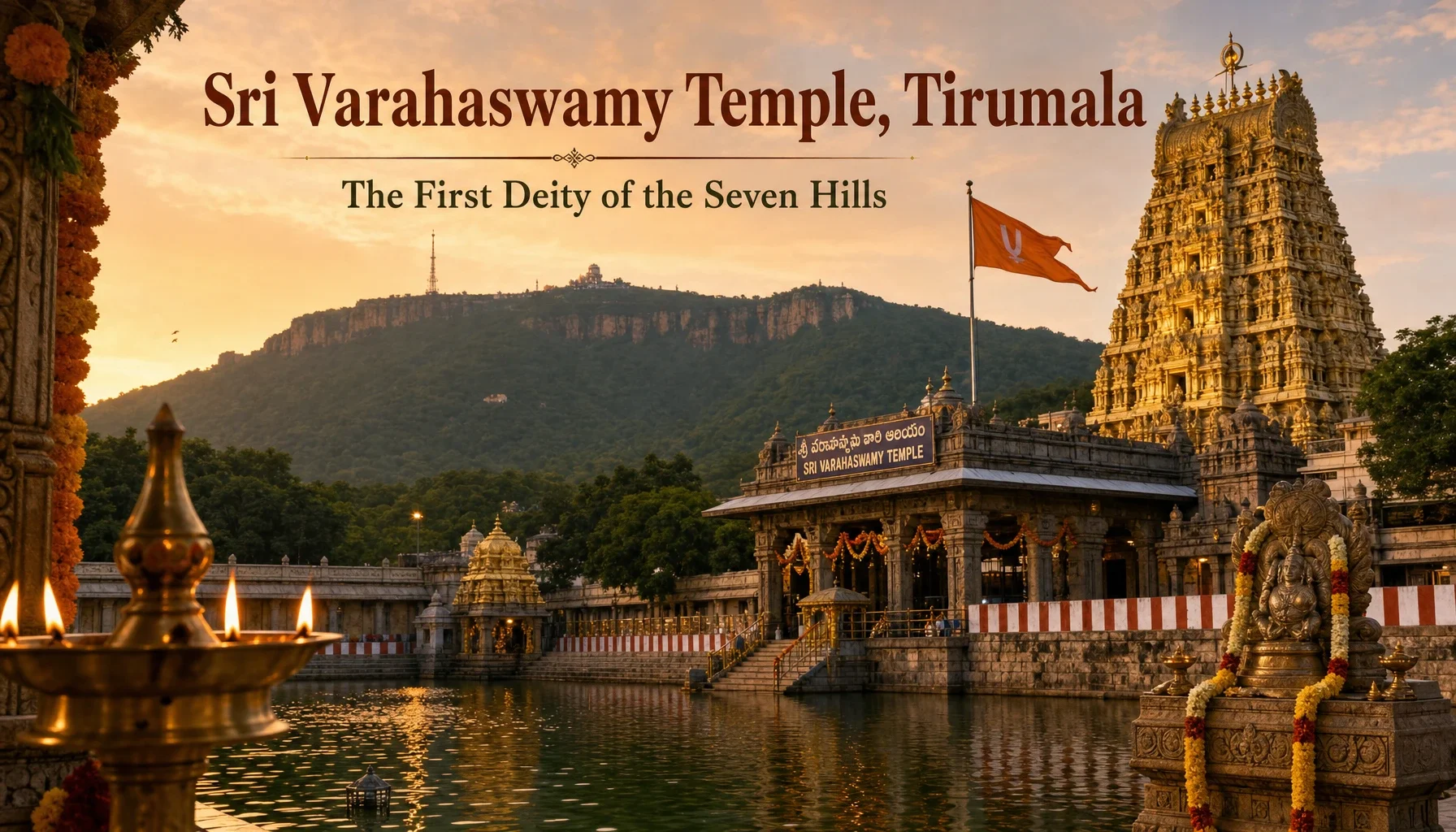
Long before the towering gopuram of Sri Venkateswara Temple drew millions of pilgrims to Tirumala each year, the sacred hills already had a resident lord. Sri Varahaswamy Temple, tucked quietly on the northern bank of the Swami Pushkarini tank, is regarded as the original shrine of Tirumala — so much so that tradition holds a pilgrimage to the hills is incomplete without first bowing before Lord Varaha. Yet many first-time visitors, swept along in the rush toward the main temple, walk right past this ancient sanctum without realizing its significance.
Table of Contents
Where the Temple Is Located
Sri Varahaswamy Temple stands in Tirumala, the hill town in Tirupati district of Andhra Pradesh, at an elevation of roughly 850 metres on the Seshachalam range. The temple sits immediately to the north of the Sri Venkateswara Temple, on the banks of the Swami Pushkarini, the sacred temple tank where pilgrims traditionally take a holy dip before darshan.
Reaching it is simple. From the Tirumala bus station, the temple is about a kilometre away, an easy walk. Pilgrims coming out of the main temple's exit, or those heading toward the Pushkarini for a bath, will find the Varahaswamy shrine right at the edge of the tank. It falls naturally on the traditional pilgrim route: bathe in the Pushkarini, offer worship to Sri Varahaswamy, and only then proceed to the sanctum of Lord Venkateswara. The temple is managed by the Tirumala Tirupati Devasthanams (TTD), the trust that administers all the shrines on the hill.
The Legend: Why Varaha Comes First
The story of this temple is woven into the very identity of Tirumala. According to the Brahma Purana and local tradition, the seven hills were originally known as Adi Varaha Kshetra — the abode of Lord Varaha, the boar incarnation of Vishnu who lifted the Earth (Bhudevi) from the cosmic waters after defeating the demon Hiranyaksha.
When Lord Vishnu descended to Earth in his form as Srinivasa (Venkateswara) during the Kali Yuga, he sought a place to reside and arrived on the northern bank of the Swami Pushkarini. The hills, however, belonged to Varaha. Lord Varaha graciously granted the land, but with a covenant: he would receive the first darshan, the first naivedyam (food offering), and the first worship from every pilgrim who came to the hills. Lord Venkateswara agreed, and to this day the temple kitchen's first offering of the day and the devotee's first visit are, by tradition, meant for Sri Varahaswamy.
Vimana Venkateswara Swamy: The Lord Atop the Ananda Nilayam
This is why elders and priests consistently advise pilgrims: darshan of Varahaswamy first, then Venkateswara. Only then is the Tirumala yatra considered complete.
The Deity and the Shrine
According to the Atri Samhita, Lord Varaha is worshipped in three forms — Adi Varaha, Pralaya Varaha, and Yajna Varaha. The deity enshrined here is Adi Varaha, the primordial form. The murti depicts the Lord with the head of a boar and a human body, a powerful image symbolizing the rescue of Mother Earth. The temple is also referred to as Sri Bhu Varahaswamy Temple, honouring the Lord together with Bhudevi.
The shrine itself is modest compared to its famous neighbour — a compact, east-facing stone temple with a small vimana over the sanctum. Historical records indicate the temple was renovated in 1535 CE by Pedda Tirumalacharya, and inscriptions suggest the shrine predates much of the structural history of the main Venkateswara temple. Worship here follows the Vaikhanasa Agama, the same ancient Vaishnava tradition observed in the main temple, with daily rituals conducted by hereditary priests.
Darshan Timings
The temple generally remains open through the day with a midday break, broadly aligned with the rhythms of the main temple. Commonly followed timings are:
Morning session: approximately 5:30 AM to 12:00 noon (some schedules extend the morning session to about 1:30 PM)
Evening session: approximately 5:00 PM to 9:00 PM (some schedules list the evening window from 3:30 PM)
Daily rituals include the early morning Suprabhatam and abhishekam (around 6:00 AM), followed by archana, naivedyam offerings, and evening worship concluding with Ekanta Seva.
A few practical points about timings:
Darshan here is free and typically quick — waits of 10 to 30 minutes are normal, and on quiet days you may walk almost straight in. There are no special paid darshan tickets for this temple; everyone joins the same queue.
Timings can shift on festival days, during Brahmotsavams, on Varaha Jayanti, and when TTD makes administrative changes. Since schedules published by different sources vary slightly, it is always wise to confirm the current day's timings on the official TTD website (tirumala.org, ttdevasthanams.ap.gov.in) or at the temple enquiry counters in Tirumala before planning your visit.
If you have a time-slotted darshan ticket for the main temple (such as Special Entry or Srivani darshan), plan your Varahaswamy visit comfortably before your slot — early morning is ideal, when the air by the Pushkarini is cool and the shrine is serene.
Tirumala Sightseeing Guide: Temples, Tourist Places, Timings, Distances & How to Reach (2026)
Festivals
The temple observes its own calendar of celebrations in addition to participating in the larger Tirumala festival cycle:
Varaha Jayanti is the most important annual festival here, commemorating the appearance of the Varaha avatar. It typically falls in the Bhadrapada month (August–September) and draws large crowds to this otherwise peaceful shrine.
Teppotsavam (float festival) sees deities taken on decorated floats around the Swami Pushkarini, turning the tank beside the temple into a spectacular sight.
During the annual Brahmotsavams of the main temple, the Varahaswamy shrine and the Pushkarini area become part of the grand processional circuit, and rituals such as Chakrasnanam take place in the adjacent tank.
Guidelines for Devotees
TTD enforces a common code of conduct across all Tirumala temples, and it applies fully here:

Dress code. Traditional attire is required. Men should wear dhoti or pyjama with upper cloth, or shirt and trousers; women should wear saree, half-saree, chudidar with dupatta, or similar traditional dress. Shorts, sleeveless tops, and other casual western wear are not permitted inside the shrines.
Footwear. Shoes and sandals must be removed well before entering the temple premises. Footwear stands are available near the Pushkarini and main temple complex.
Mobile phones and electronics. Cell phones, cameras, and electronic gadgets are strictly prohibited inside the temple. Deposit them at your accommodation or at the designated luggage/phone counters before joining the queue. Photography of the deity is not allowed.
Order of worship. Follow the tradition: take a bath (ideally in the Swami Pushkarini or at your lodging), have darshan of Sri Varahaswamy first, and then proceed to the Sri Venkateswara Temple.
Conduct inside. Maintain silence or soft prayer, follow queue discipline, and cooperate with security checks. Keep children close, especially near the tank steps.
Prohibited items. Plastic bags, tobacco, alcohol, and non-vegetarian food are banned throughout Tirumala. The entire hill town is a strictly vegetarian zone.
Offerings. Devotees may offer archana and naivedyam through the temple priests. Hundi offerings can be made in the temple's hundi. There is no online seva booking specific to this shrine; sevas are handled at the temple itself.
Health and accessibility. The walk from the main temple or bus stand is short but involves some steps around the Pushkarini. Elderly pilgrims should take it slowly; the path is otherwise easy and well maintained.
Verify before you go. Festival days, VIP visits, and special rituals can alter queue arrangements and timings without much notice. A quick check with TTD's official channels saves disappointment.
Free Accommodation at Tirumala: Complete Guide to Cottages & Choultries
A Visit Worth Making
Standing at the edge of the Swami Pushkarini in the early morning, with the golden gopuram of the main temple rising behind you and the small, ancient shrine of Varahaswamy before you, it is easy to feel the layered history of Tirumala. This is where, as the puranas tell it, the story of the seven hills began. The crowds are thin, the darshan unhurried, and the atmosphere deeply peaceful — a striking contrast to the grandeur next door.
So when you next climb the hills to see Lord Venkateswara, pause first at the home of the hills' original lord. Tradition says your pilgrimage isn't complete without it — and after a few quiet minutes in this ancient sanctum, you'll understand why the custom has endured for centuries.
Note: Timings and procedures are subject to change by TTD. Please confirm current schedules at tirumala.org or TTD enquiry counters before your visit.
