
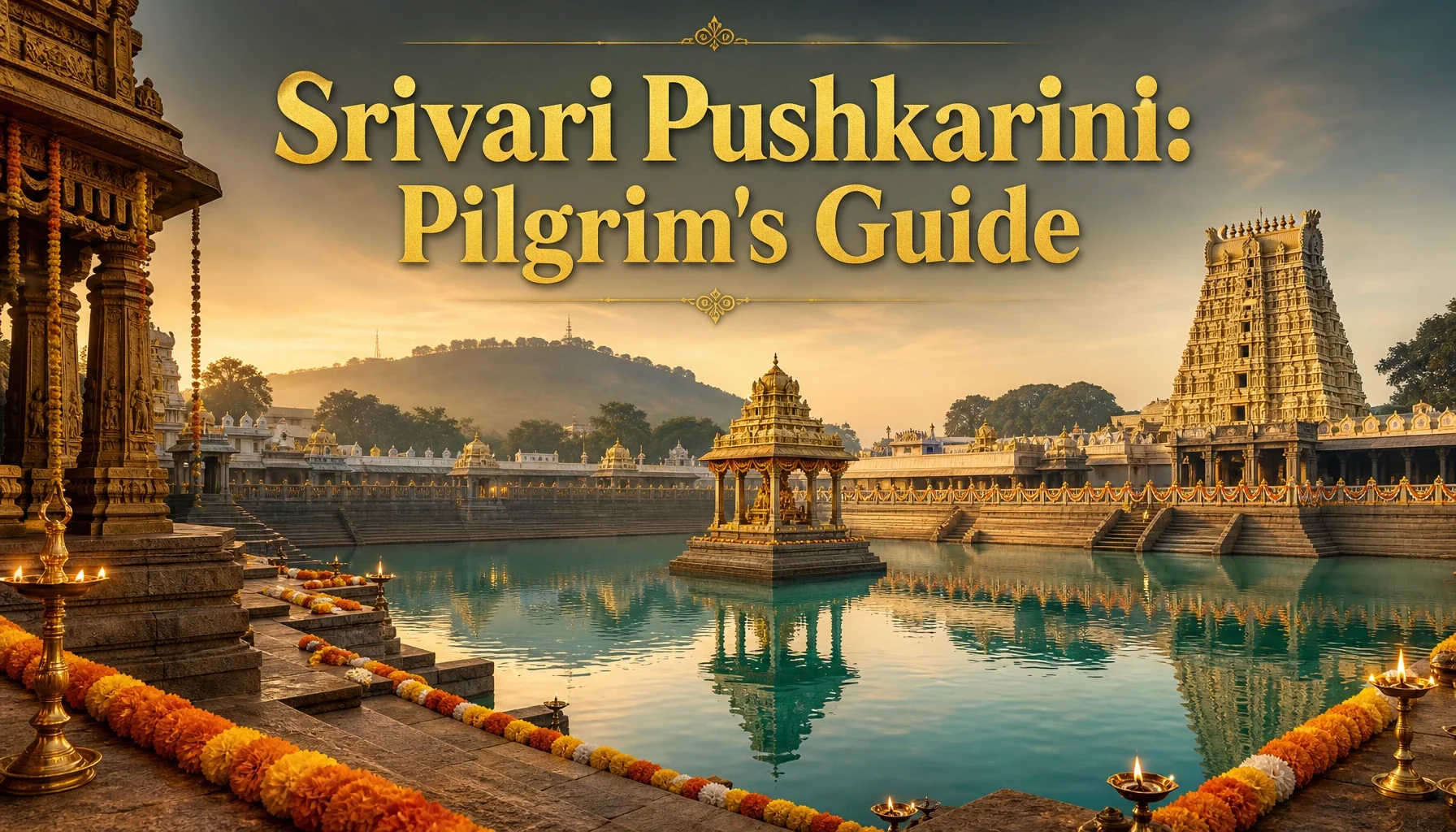
Nestled beside the world-famous Sri Venkateswara Swamy Temple in Tirumala, the Srivari Pushkarini — more popularly known as Swami Pushkarini — is one of the most sacred water bodies in all of India. For centuries, pilgrims climbing the seven hills of Tirumala have made it a point to take a holy dip in this temple tank before proceeding for darshan of Lord Venkateswara. This article covers everything a devotee needs to know: the legend and history of the Pushkarini, its timings, the exact location and how to reach it, the guidelines to follow while bathing, and the festivals celebrated on its banks.
Table of Contents
The Sacred Legend
According to the Puranas, Swami Pushkarini was not originally of this earth. It was a pleasure lake of Lord Maha Vishnu in Vaikuntha, his celestial abode. When the Lord descended to earth as Sri Venkateswara in Kali Yuga, Garuda — the divine eagle and vehicle of Vishnu — brought the lake down from Vaikuntha and placed it on the Venkatadri hills for the Lord's use. It is believed that Lord Venkateswara himself, along with his consorts, bathed and sported in these waters, which is why the tank is called "Swami" Pushkarini — the Lord's own tank.
The scriptures describe Venkatadri as "Tirthadri," the hill of sacred waters, home to 1,008 theerthams. Among all of them, Swami Pushkarini is considered the foremost. The Puranas narrate that sages, and celestial beings such as Kubera, Chandra, Indra and Manmatha bathed here at different times and earned immense punya. It is said that King Dasharatha was blessed with Lord Rama as his son after bathing in this tank, and that a dip here grants the merit of bathing in all the theerthams of the universe. A bath in Swami Pushkarini is traditionally held to be as meritorious as a bath in the holy Ganga.

Tradition holds that three things are essential in a Tirumala pilgrimage: a holy dip in Swami Pushkarini, darshan of Sri Varahaswamy, and darshan of Lord Sri Venkateswara — in that order.
Vimana Venkateswara Swamy: The Lord Atop the Ananda Nilayam
History and Architecture
The Pushkarini has a documented history stretching back many centuries. The tank spreads over roughly one and a half acres, with stone steps (ghats) leading down to the water on all sides. At its centre stands a beautiful mandapam (Neerali Mandapam) crowned with a gopuram, built by the Saluva king Narasimha Raya in 1468 CE. The saint-poet Tallapaka Annamacharya is credited with helping construct the steps leading to this central mandapam. Inscriptions from the 12th century and the era of Sri Krishnadevaraya of Vijayanagara refer to the daily worship of the tank.
In modern times, the TTD (Tirumala Tirupati Devasthanams) has installed advanced filtration and recycling systems. The water is continuously recycled, treated and chlorinated round the clock for the safety and hygiene of pilgrims, and the tank is periodically drained and refilled with fresh spring water.
Location and How to Reach
Swami Pushkarini lies immediately adjacent to the main Sri Venkateswara Temple in Tirumala, about one kilometre from the Tirumala bus station — an easy walk from the main temple queue lines and cottages.
- On its southern bank stands the Sri Venkateswara Swamy Temple.
- On its western bank stands the Sri Bhu Varahaswamy Temple.
- Entrance for bathing: The bathing area is reached from beside/behind the Sri Varahaswamy Temple. Follow the signage for "Pushkarini / Varahaswamy Temple" to locate the bathing ghat.
Timings of Srivari Pushkarini
- The Pushkarini is open 24 hours a day, all days of the year. There is no fixed opening or closing time, and no ticket or entry fee is required for the holy bath.
- Best time for the holy dip: The Brahma Muhurtham (roughly 4:00 AM – 6:00 AM) is considered the most auspicious time. Traditionally, devotees bathe here before proceeding for Suprabhata darshan of the Lord.
- To avoid crowds: Early morning or late evening visits offer a calmer, more serene experience. Weekends and festival days see the heaviest rush.
- Pushkarini Harathi: A daily evening harathi (usually after 6:00 PM) is offered to the Pushkarini, a ritual revived by TTD based on centuries-old inscriptions. Devotees may witness this beautiful ceremony freely; no tickets are needed.
- Temporary closures: Occasionally, sections of the tank may be closed for maintenance, water replacement, or festival preparations (such as before Teppotsavam or Chakrasnanam). Always check the TTD notices on arrival.

Important Guidelines to Follow at the Pushkarini
To preserve both the sanctity and the safety of this holy tank, pilgrims should observe the following rules and customs:
Tirumala Sightseeing Guide: Temples, Tourist Places, Timings, Distances & How to Reach

Bathing rules
- Bathe only in the designated area. Bathing is permitted only on the side near the Sri Varahaswamy Temple. The other banks of the tank are strictly out of bounds for bathing.
- Take the dip before darshan. As per tradition, the Pushkarini snanam should precede darshan — first the holy dip, then darshan of Sri Varahaswamy, and finally darshan of Lord Venkateswara.
- Children must never be allowed to enter the water alone. They should always be accompanied and closely supervised by adults. Elderly devotees and those unable to swim should hold the railings/steps and take only a gentle dip at the shallow steps.
- Do not swim, dive, or venture into deep water. The tank is for a ritual dip, not swimming.
- Private poojas and rituals are banned at the tank. Do not perform personal poojas, homams, pinda pradanam, or leave offerings, flowers, coconuts, oil, camphor or lamps in or around the water. Offerings should be made only in the temple hundi.
Dress code and modesty
- Dress modestly, as befits temple premises. Traditional attire is preferred — dhoti/pancha or pyjama-kurta for men, saree, half-saree or churidar with dupatta for women. Shorts, sleeveless tops, and revealing western wear are inappropriate.
- Bathe with clothes on — never undress fully at the ghats. Carry a dry set of clothes and change in the designated rooms.
- Changing rooms and washrooms are available separately for gents and ladies right next to the bathing area. Note that the bathing ghat itself is common; there are no separate bathing sections for men and women, so modesty must be maintained at all times.
Cleanliness and conduct
- Do not use soap, shampoo or detergents in the tank. The water is sacred and is also used for temple rituals.
- Do not spit, wash clothes, or pollute the water in any manner. Keep the ghats litter-free; use dustbins.
- Remove footwear before descending the steps to the water; footwear is not permitted in the inner sacred areas.
- Maintain silence and devotion. The Pushkarini is a place of worship, not a picnic spot. Avoid loud conversation, playing in the water, or splashing others.
- Photography and videography are restricted in and around the temple premises; mobile phones and cameras are generally not allowed near the main temple area — deposit them at the designated counters or leave them at your accommodation.
- Guard your belongings. Carry minimal valuables to the ghat. Keep bags in view or leave them with a family member while bathing.
- General Tirumala rules apply: smoking, alcohol, tobacco and non-vegetarian food are strictly prohibited anywhere in Tirumala.
Health and safety tips
- If you have heart conditions, blood pressure issues or are unwell, take only a token sprinkle (prokshana) of the holy water on your head instead of a full dip — the merit, as tradition says, comes from devotion.
- The hill weather can be chilly, especially in the early morning hours and in winter (November–February); dry yourself and change quickly after the dip.
- The water is treated and recycled continuously, but avoid swallowing it.
Festivals Celebrated at Swami Pushkarini
The Pushkarini is the venue of some of Tirumala's most spectacular rituals:
- Chakrasnanam (Avabhruda Snanam): On the concluding day of the annual Brahmotsavams, Sri Sudarshana Chakra and the utsava deities are given a ceremonial bath in the Pushkarini after the morning rituals. Thousands of devotees take a dip in the tank at the same time, sharing in the divine snanam — one of the most cherished moments of the Tirumala calendar.
- Daily Sevas in Tirumala: Complete Guide to Moola Virat & Malayappa Swamy Rituals (Timings, Day-Wise Schedule & Special Sevas)
- Teppotsavam (Float Festival): A five-day festival, usually in February–March, when the utsava idols of the Lord and his consorts are taken on a beautifully decorated float around the illuminated Pushkarini.
- Mukkoti Dwadasi: On the Dwadasi of the bright fortnight of Dhanurmasa, it is believed that over three crore (mukkoti) theerthams of the universe merge into Swami Pushkarini. A dip on this day is considered supremely meritorious — equal to bathing in the Ganga itself.
- Daily Pushkarini Harathi: Every evening, priests offer harathi to the sacred waters, a ritual rooted in 12th-century inscriptions.
Suggested Pilgrim Sequence
- Reach Tirumala and freshen up at your accommodation.
- Proceed to Swami Pushkarini (preferably in Brahma Muhurtham) and take the holy dip on the Varahaswamy Temple side.
- Change into dry, clean traditional clothes in the changing rooms.
- Have darshan of Sri Bhu Varahaswamy on the western bank — traditionally done before the main darshan.
- Proceed to the main temple for darshan of Lord Sri Venkateswara.
Conclusion
Srivari Pushkarini is far more than a temple tank — it is a living link between Vaikuntha and the earth, sanctified by legend, history and the unbroken devotion of millions of pilgrims. Open round the clock and free for all, it invites every devotee to wash away weariness and worldly cares before standing in the presence of Lord Venkateswara. By following the simple guidelines of modesty, cleanliness, safety and reverence, every pilgrim can make the Pushkarini snanam a truly purifying beginning to their Tirumala yatra.
Om Namo Venkatesaya!
Note: Timings and rules are as per prevailing TTD practice and may change during festivals or maintenance. Please check the latest TTD notices at Tirumala or ttdevasthanams.ap.gov.in before your visit.
